 jsontoschema
JSON to TypeScript: do you actually need full types?
TypeScript converters produce interfaces, generics, and type aliases. Sometimes all you need is the structure.
Same JSON, two approaches
A JSON-to-TypeScript converter takes an API response and produces named interfaces with extracted nested types. That's useful inside a codebase, but it's more than you need when you just want to understand what the data looks like.
interface Address {
  city: string;
  zip: string;
}

interface User {
  id: number;
  name: string;
  email: string;
  role: string;
  verified: boolean;
  address: Address;
  tags: string[];
}{
id: number,
name: string,
email: string,
role: string,
verified: boolean,
address: {
city: string,
zip: string
},
tags: string[]
}The schema on the right keeps every structural detail (nesting, types, arrays) without introducing names or indirection. You can read it at a glance.
When TypeScript types make sense
TypeScript types are the right tool when you're writing application code. They give you compile-time safety, IDE autocomplete, refactoring support, and documentation that lives next to your implementation.
If you're building a typed API client, defining data models, or sharing types across files, use a proper TypeScript converter.
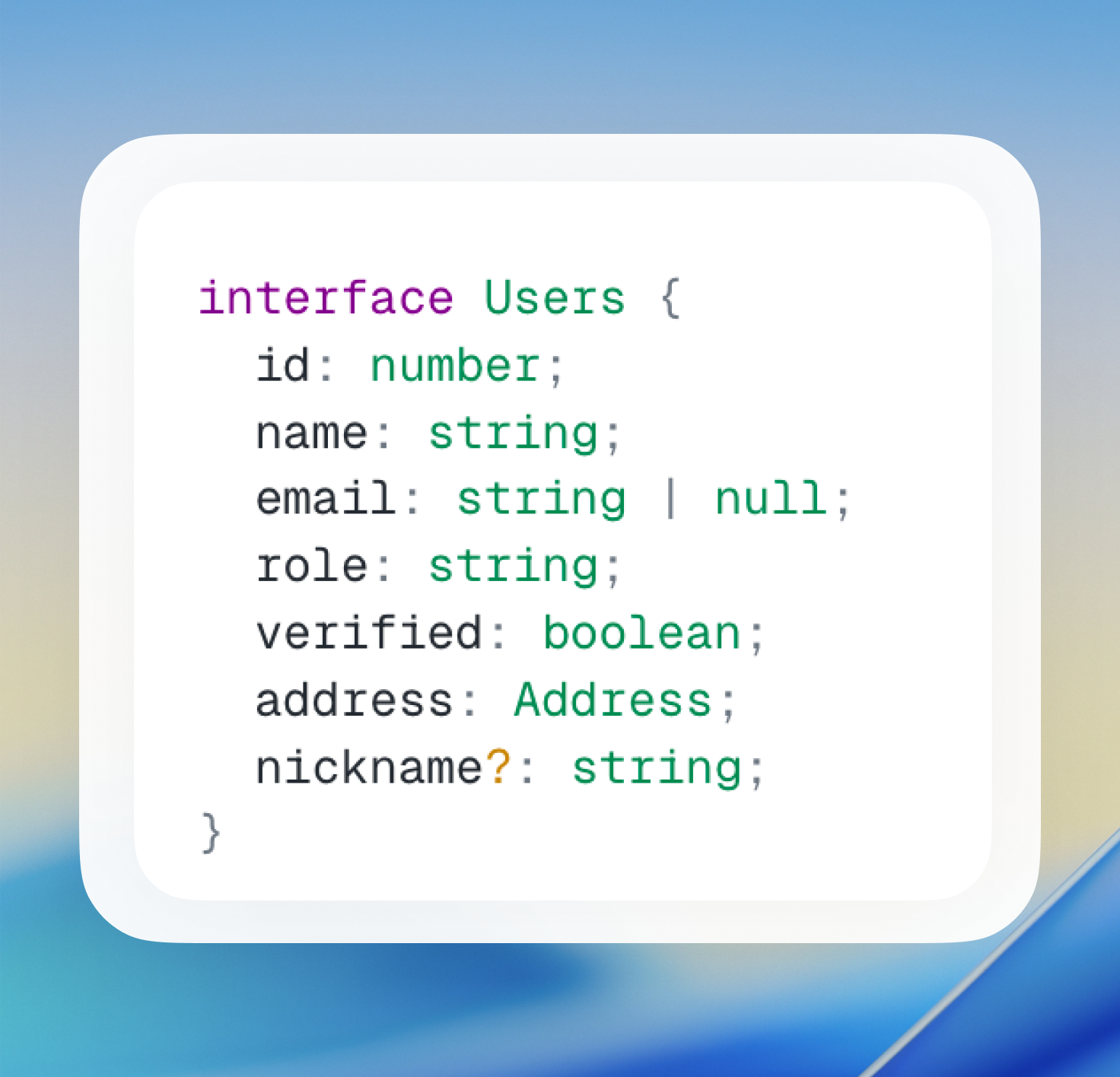
When a simplified schema is enough
A simplified schema works better when your goal is comprehension, not compilation: describing an API response in docs, giving an LLM context about a JSON structure, debugging an unfamiliar endpoint, or dropping a data shape into a Slack message or PR description.
In those cases, named interfaces are noise. You don't need Address as its own type. You need to see that address contains a city and zip string.
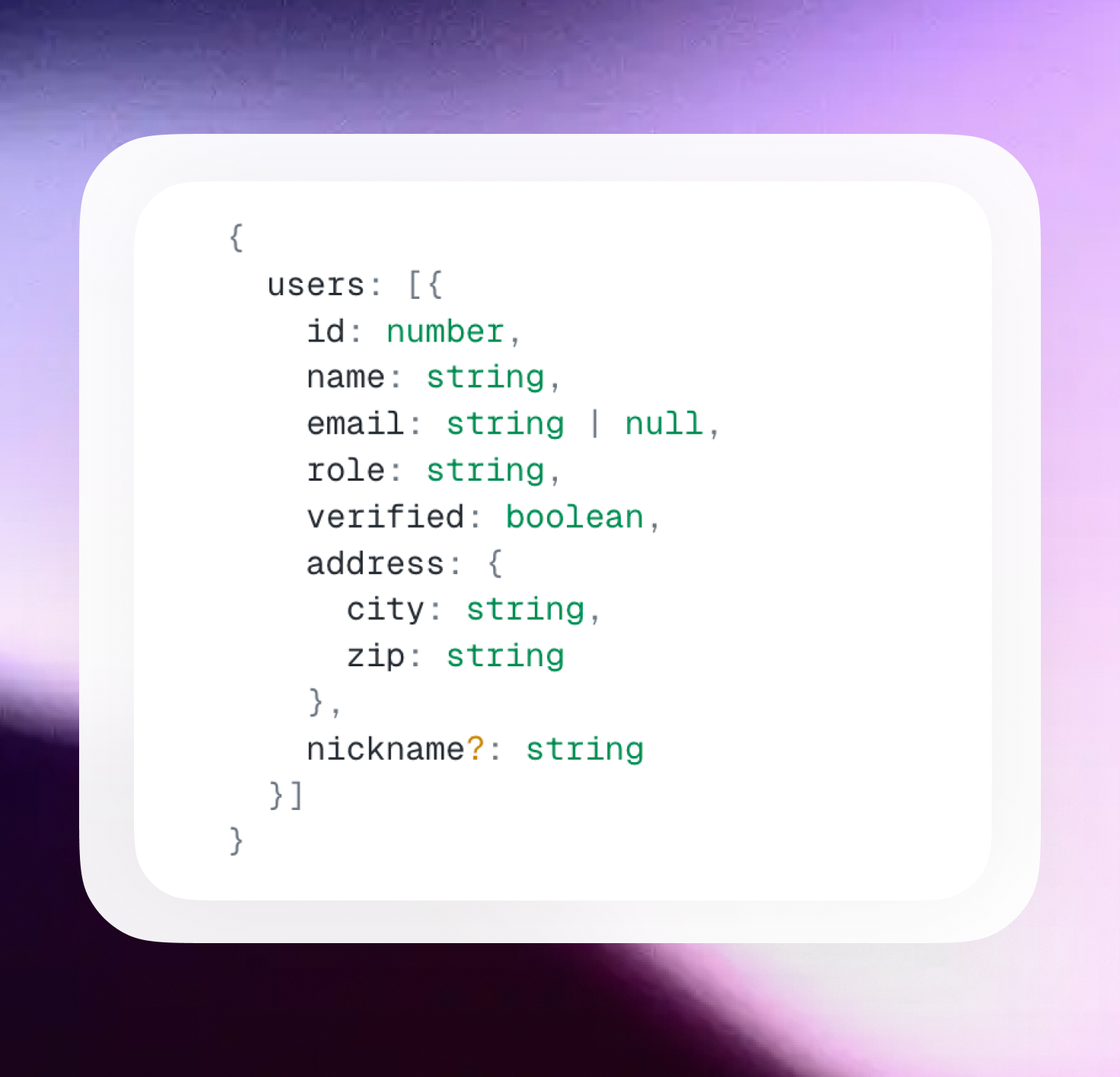
The token cost of TypeScript types
When you pass JSON structure to an LLM, every token counts. TypeScript's interface declarations and named types consume tokens without helping the model understand the data any better.
~350
tokens for raw JSON
~120
tokens for TypeScript types
~80
tokens for simplified schema
For larger payloads the gap grows fast. A 50,000-token API response can be represented in under 500 tokens as a schema, regardless of how many items the arrays contain.
How array merging works
Most TypeScript converters look at a single object to generate a type. jsontoschema inspects every item in an array, merges their fields, and marks fields that only appear in some items with ?.
[
  { "id": 1, "name": "Deploy v2.4",
    "status": "completed",
    "duration": 84,
    "error": null },
  { "id": 2, "name": "Deploy v2.5",
    "status": "failed",
    "duration": 12,
    "error": "timeout",
    "retryCount": 3 }
][{
id: number,
name: string,
status: string,
duration: number,
error: string | null,
retryCount?: number
}]Common questions
Is this a replacement for TypeScript?
No. TypeScript types and a simplified schema solve different problems. Use TypeScript in your code, and a schema for docs, LLM context, or quick comprehension.
Can I paste the schema output into TypeScript?
Not directly. The output has no interface declarations or exports. It's meant to be read by humans and LLMs, not compiled.
Does it handle deeply nested objects and arrays?
Yes. The full nesting depth is preserved, including mixed types, nullable fields, and optional properties, all inline without extracting named types.
Try it yourself
Paste any JSON and get the structure back in seconds. No sign-up required.